Article: The Highgate Collection: An ancient language, a new material
The Highgate Collection: An ancient language, a new material

Imagine, some two thousand years ago, an ordinary day for potters working in what is now Highgate. A normal day of making ceramic vessels for everyday needs, interrupted every so often by the crack of a broken pot – followed, one imagines, by a shout, a curse and the momentary frustration of seeing some of the day’s work in pieces.
What’s less ordinary is that those same failed pieces, discarded at the time, left behind fragments that now reveal how these objects were made, fired and used.
Fast-forward our story to today, and those fragments have become the starting point for The Highgate Collection, a new collaboration between HOST and London-based sculptor, ceramicist and educator, Shem Morgan.
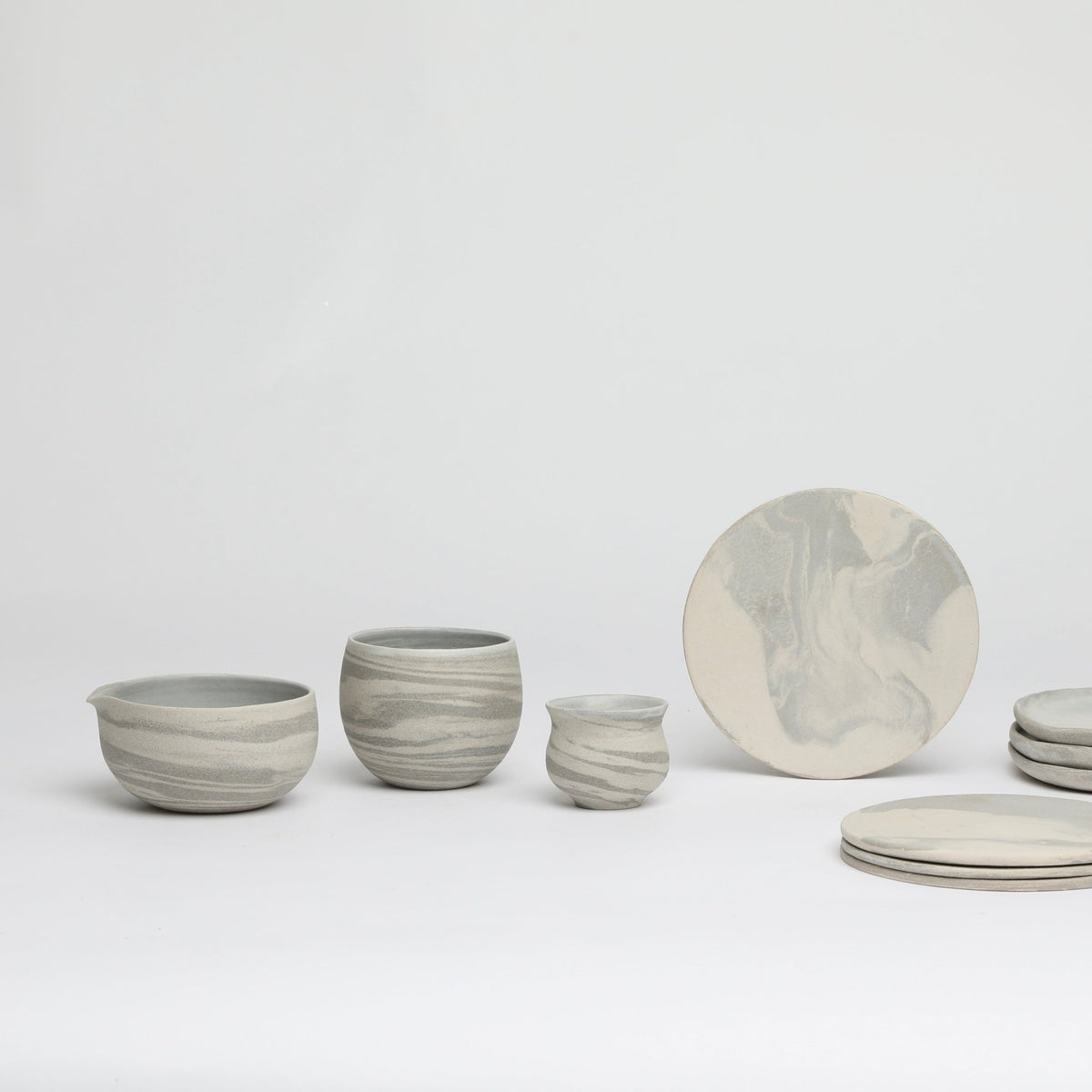
Developed in ReCinder, this limited edition of functional art translates an ancient ceramic language into a family of contemporary objects, connecting two very different moments in ceramic production through something they unexpectedly share – waste.
Ancient discarded ceramics become the reference for new vessels made from reclaimed ceramic waste - a fascinating exploration and rediscovery of an ancient ceramic language, reimagined through an entirely new material that might just be offering another future for ceramic production.
From sherd to vessel
Produced in Highgate, London, the collection is inspired by ancient ceramics and more specifically, by sherds – indeed, sherds, not shards – dating from the Roman period. Provenance, however, isn’t the collection’s only connection to its name.
The fragments originate from Shem’s own searches and digs in Highgate Wood, undertaken as part of his ongoing research into local clay deposits and the Roman pottery-manufacturing site discovered there in the 1960s.
Dating approximately from AD 40–150, many are believed to be fragments of waster pots - vessels that failed during firing or broke at the pottery and consequently never made it to market.
Destiny, coincidence or simply a stroke of luck – call it what you like. Nearly two thousand years later, these humble discarded fragments are being used to teach a new generation of potters about ancient throwing techniques, and have now - become the reference for an entirely new collection made from another discarded ceramic resource - ReCinder.
There is something rather fitting about waste from one period of ceramic production helping us rethink the waste of another. And perhaps fragments from this collection will themselves be studied in the distant future, recreating that connection through time once again.
As Shem explains:
“When breaking a pot by accident in the studio today, there is always that cringe of grief, quickly followed by looking at the side profile to understand where we can improve. It seems rather fitting that, nearly 2,000 years later, we are using these broken pieces to do exactly the same.”
This relationship between past and present sits at the heart of Shem’s practice. Working primarily with traditional methodologies and raw clays, his work explores the context and continuum of historical ceramic vessels. His silhouettes balance a distinct contemporary identity with a museological attentiveness to ancient pottery, including an understanding and acceptance of the inherent unknowns that surround it.
Experiential learning is central to his practice. Archaeological finds become points of departure for investigating historical processes and reproducing theorised methods of making, allowing knowledge to emerge not simply through studying an object, but through the physical act of attempting to make it again.
Through this cross-generational engagement, Shem seeks to preserve increasingly scarce traditions of making and pass them forward, allowing future potters to engage with, learn from and ultimately enrich this heritage craft.
Learning from an ancient language
The surviving sherds reveal a coherent language of making: rolled rims, compressed bases, thinly thrown midsections, little decoration and predominantly unglazed surfaces, fired to the clays highest limits in order to vitrify and seal the ceramic body.
Historical evidence also points to many utilitarian vessels having no foot ring, allowing Roman potters to produce them efficiently and with minimal intervention. These were functional objects in which decisions about form, material and production were closely connected to the way an object would ultimately be used.
Rolled rims were also common on storage vessels, adding durability to one of the most vulnerable parts of the pot. The process is much as it sounds - the rim is first thinned to approximately half the width of the walls and then rolled back, compressing it into the pot wall and creating a slightly outward-curving edge.
Beyond strengthening the rim and helping prevent chips, this profile also allowed cloth or animal hide to be draped over and tied tightly with string to help seal the contents within.
Drawing on the historical evidence available, Shem has translated these characteristics into a family of timeless silhouettes reminiscent of amphorae and other Roman storage vessels - reconstructed not as replicas, but as distinctly contemporary interpretations in ReCinder.
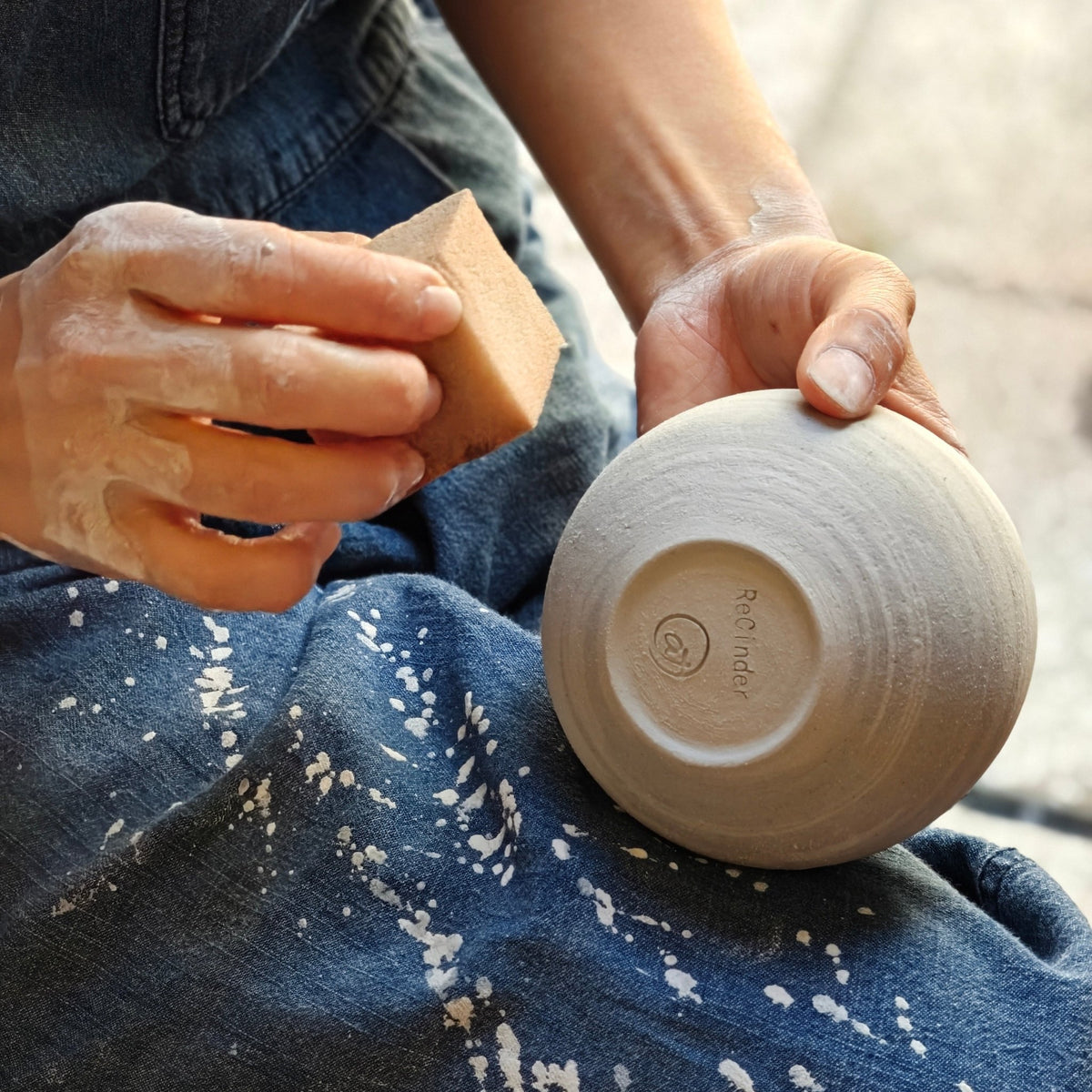
Working with ReCinder has introduced another material language, one defined by a texture Shem describes as having a sandstone-like quality: “This sandstone quality is something I haven’t been able to find in other clay bodies before.”
Its inclusions, revealed during the trimming phase, leave tiny cavities across the surface, reminiscent of weathered stones found around cathedral grounds, making each object subtly individual and inherently collectable.
But the creative process has room for spontaneity too. On several pieces, jagged rims that emerged during making were deliberately retained. Unexpectedly, they began to resemble the broken sherds from which the vessels themselves had been developed – the material seemingly finding its own way back to the original reference.
Leaving a mark without a name
Another historical reference lies in what is absent.
Maker’s marks appear only later in the archaeological record, leaving the identities of countless ancient potters unknown. What survives instead is their work: the decisions of the hand, the material and the form.
Fascinated by the thought that the ceramics he makes may outlast both himself and those who know him, Shem follows those unnamed makers:
“It seems fitting that someone could potentially hold a pot I made hundreds of years from now and not know the maker.”
So he follows in the footsteps of the thousands of unnamed potters before him, leaving his mark through object and form rather than writing. Instead, each piece is tagged – a playful reference to the cataloguing systems through which historical objects are identified, recorded and understood today.
The material revealed
The Highgate collection combines glazed and unglazed vessels, with many surfaces deliberately left exposed. For Shem, this was an important decision:
“I’ve chosen to keep the pots unglazed for this collection – I wanted the stone-like texture of ReCinder to be on full show.”
The decision references the archaeological pieces while also giving ReCinder itself room to speak. From coarse and grainy surfaces to the inclusions revealed through making, the material is allowed to retain its own distinct character.
As Shem puts it, “it would have been a shame to cover them up.”
Quite fittingly, the collection also draws upon one of pottery’s oldest finishing techniques - burnishing.
Using a smooth river stone, the exterior of the pot is repeatedly worked when the clay reaches just the right moisture level. The process compresses and smooths the surface, stretching the clay particles across the exterior and, when carried out sufficiently, helping to seal the surface while allowing the character of the clay body to remain visible.
To keep the unglazed pieces watertight, they are saturated with beeswax – a method also used historically to seal Roman amphorae. By repeatedly heating the vessels and applying several layers of beeswax, sufficient wax is absorbed into the pores of the ceramic body to create a waterproof seal and antibacterial barrier.
Rather than concealing ReCinder beneath a conventional glaze, these processes allow the unusual texture, inclusions and character of the reclaimed material to remain central to the finished object.
Ancient process. Contemporary resource.
There is something else surprisingly contemporary about looking backwards.
Where appropriate, vessels in the collection achieve their finished ceramic body through a single firing, removing the need for the second firing conventional to much of contemporary glazed ceramic production and reducing the energy required in the process.
There is also a striking geographical connection.
Just as ancient potters worked with resources available around them, The Highgate Collection is ultra-local, made in Highgate from ReCinder produced using ceramic waste also sourced from the area’s ceramic studios.
The ancient sherds and the contemporary maker, the reclaimed material and the finished objects exist in remarkable harmony within an unusually concentrated geography.
For HOST, however, the significance of the collaboration extends beyond the objects themselves.
Placing ReCinder in the hands of an artist with an established material language allows us to understand not simply what the material can replace, but what new possibilities it can create.
That distinction is important.
The ambition of circular design should not only be to reproduce existing objects using less harmful resources. New materials can influence how objects are formed, finished and understood. Their imperfections can become characteristics, their limitations can provoke different processes, and their histories can become part of the objects themselves.
In The Highgate Collection, an archaeological fragment discarded by one ceramic industry becomes a reference to another. What began as waste becomes knowledge, and that knowledge becomes an object once again.
The principle is ancient, but the resource is new – challenging us to reconsider what we call waste, and offering an insight into what the future of these raw materials might look like.